
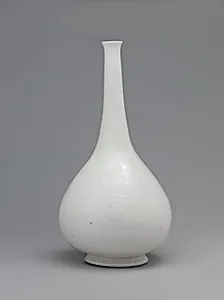
Bottle with Incised Decoration
Unknown Artist
first half 18th century
Medium
Stonepaste; incised under transparent glaze (Gombroon ware)
Dimensions
H. 14 in. (35.6 cm)
Classification
Ceramics
Department
Islamic Art
Museum
Metropolitan Museum of Art, New York, NY
Credit
Edward C. Moore Collection, Bequest of Edward C. Moore, 1891
Accession Number
91.1.131
Rights
Public Domain
Art Historical Context
This elegant *Bottle with Incised Decoration*, crafted in the first half of the18th century, exemplifies the refined artistry of Islamic ceramics from Persia (modern-day Iran). Standing at 14 inches tall, it belongs to the prestigious Gombroon ware tradition named after the port of Bandar Abbas (formerly Gombroon), through which these luxurious pieces were exported to Europe and beyond. Produced likely in Kirman, this stonepaste vessel—made from a composite of quartz, clay, and glass frit—demonstrates the Islamic world's innovative response to Chinese porcelain, achieving a durable, porcelain-like whiteness without true kaolin. The artwork's standout feature is its incised decoration, where intricate motifs are meticulously carved into the unfired body before applying a transparent glaze. This technique creates subtle texture and depth, with the glaze pooling in the incisions to highlight patterns that might include floral or geometric designs typical of the period. Firing the piece seals the design, ensuring both beauty and functionality for holding liquids or as a decorative object. Now part of the Metropolitan Museum of Art's Edward C. Moore Collection (bequest of 1891), this anonymous masterpiece invites us to appreciate the anonymous skilled hands behind Persian ceramic mastery—bridging utility, trade, and timeless aesthetic appeal in Islamic art.