
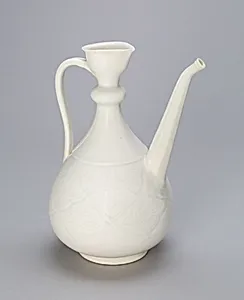
Ewer with Incised Floral Decoration
Safavid dynasty (1501-1722), late 17th/early 18th century
Medium
Gombroon ware, fritware with incised decoration under transparent glaze
Dimensions
23.7 × 17.7 × 13.9 cm (9 5/16 × 7 × 5 1/2 in.)
Classification
ewer (vessel)
Department
Arts of Asia
Museum
Art Institute of Chicago
Accession Number
69725
Rights
Public Domain
About this artwork
This elegant ewer features lightly incised decoration under a transparent glaze. A type of ceramics commonly known as Gombroon ware, the name is derived from the port of Bandar-e 'Abbas (known as Gombroon by the British), from where these ceramics were exported in the 18th century. Both the Dutch and English East India Companies populated Bandar-e 'Abbas and traded heavily in ceramics. This ware was popular outside of the Islamic world because its delicate, glassy appearance was thought to close...
About the Artist
Islamic
Islamic art, a profound visual tradition originating in the 7th century CE, flourished across vast territories from Spain to India under Muslim rule, encompassing architecture, ceramics, manuscripts, textiles, and metalwork produced by diverse artisans rather than a single named master. Drawing from pre-Islamic Sasanian, Byzantine, and late antique influences, its early development under the Umayy...