
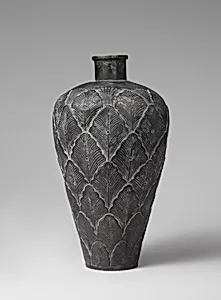
Bottle with Overlapping Petals
Unknown Artist
11th–early 12th century
Medium
Silver with chased, repoussé, and incised decoration
Dimensions
H. 8 1/4 in. (21 cm); Diam. 4 13/16 in. (12.2 cm); Diam. of rim 1 1/2 in. (3.8 cm); Diam. of base 2 1/8 in. (5.4 cm)
Classification
Metalwork
Culture & Period
China · Northern Song dynasty (960–1127)
Department
Asian Art
Museum
Metropolitan Museum of Art, New York, NY
Credit
The Miriam and Ira D. Wallach Foundation Fund and Seymour Fund, 2006
Accession Number
2006.306
Rights
Public Domain
Art Historical Context
Step into the refined world of Northern Song dynasty (960–1127) China with this exquisite *Bottle with Overlapping Petals*, silver vessel crafted in the 11th to early 12th century Standing at 8¼ inches tall with a slender neck and flared base, its surface blooms with intricate floral motifs—likely stylized lotus or peony petals—evoking the natural elegance prized by Song elites. This anonymous masterpiece, now in the Metropolitan Museum of Art's Asian Art collection, exemplifies the period's mastery of metalwork, blending functionality as a wine ewer or incense holder with stunning ornamental beauty. The bottle's decoration showcases advanced silversmithing techniques: *repoussé* (hammering from the reverse to raise motifs), *chased* (refining details from the front), and *incised* (fine line incisions for texture). These methods created a dynamic, overlapping petal design that catches the light, symbolizing abundance and purity in Chinese culture. During the Northern Song, an era of cultural flourishing amid urban prosperity, such luxury items were status symbols for scholar-officials, reflecting the dynasty's aesthetic shift toward subtle naturalism over bold Tang extravagance. This rare survivor offers a glimpse into everyday opulence, highlighting silver's prestige before porcelain dominated. Acquired through the Miriam and Ira D. Wallach Foundation Fund, it invites visitors to marvel at the artisan's precision and the timeless allure of Song ingenuity.