
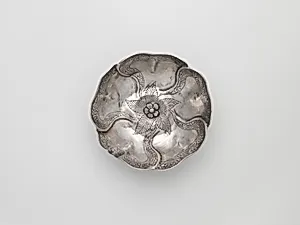
Cup with Floral Scrolls
Unknown Artist
late 12th century
Medium
Silver with chased and repoussé decoration
Dimensions
H. 1 3/8 in. (3.5 cm); Diam. 3 3/4 in. (9.5 cm); Diam. of foot 1 1/2 in. (3.8 cm)
Classification
Metalwork
Culture & Period
China · Southern Song dynasty (1127–1279)
Department
Asian Art
Museum
Metropolitan Museum of Art, New York, NY
Credit
Fletcher Fund, 1924
Accession Number
24.208.3
Rights
Public Domain
Art Historical Context
This delicate silver cup, crafted in late 12th-century China during the Southern Song dynasty (112–1279), exemplifies era's refined metalworking artistry. Measuring just 1⅜ inches tall with a 3¾-inch diameter, it was likely used for sipping wine or tea among the elite, reflecting the dynasty's cultural flourishing after the Jurchen conquest displaced the court southward to Hangzhou. The Southern Song period is celebrated for its elegant aesthetics, seen in ceramics, paintings, and now this exquisite metalwork, which prioritized subtle beauty and technical mastery. The cup's surface features chased and repoussé decoration—techniques where silver was hammered from both front (chasing) and back (repoussé) to create raised floral scrolls and leafy motifs, evoking nature's abundance. These intricate designs, common in Song decorative arts, symbolize harmony and prosperity, rendered with a precision that highlights the anonymous artisan's skill. Adorned with a slender foot for stability, the cup's saucer-like form underscores its functionality as a luxury item, blending utility with poetic ornamentation. Today, housed in the Metropolitan Museum of Art's Asian Art Department (Fletcher Fund, 1924), this rare survivor offers a glimpse into Song opulence, where everyday objects became canvases for artistic expression. Visitors, imagine holding its cool silver weight— a tangible link to a golden age of Chinese refinement.