
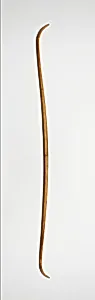
Bow
Unknown Artist
ca. 1492–1473 B.C.
Medium
wood
Dimensions
Length tip to tip 178.3 cm (70 3/16 in.); Length of outer curve 185.5 cm (73 1/16 in.); Greatest diam. 2.9 cm (1 1/8 in.)
Classification
Bow
Period
New Kingdom
Department
Egyptian Art
Museum
Metropolitan Museum of Art, New York, NY
Credit
Rogers Fund, 1936
Accession Number
36.3.212
Rights
Public Domain
Art Historical Context
Step into the world of ancient Egypt's New Kingdom with this remarkable wooden bow, crafted around 1492–1473 B.C. during Dynasty 18—a golden age of imperial expansion under pharaohs like Those III and Hatsheut. Measuring an impressive 178.3 cm from tip to tip (with an outer curve of 185.5 cm), this slender weapon (just 2.9 cm in diameter at its thickest) exemplifies the engineering prowess of Egyptian artisans. Acquired through the Rogers Fund in 6, it now resides in the Metropolitan Museum of Art Egyptian Art collection. Made entirely of wood, this self-bow represents a foundational technology in Egyptian archery, predating the more complex composite bows that would incorporate horn and sinew for greater power. Its length allowed for a powerful draw, essential for chariot-mounted warriors who rained arrows on enemies during campaigns into Nubia and the Levant. Such bows were not mere tools but symbols of military might, underscoring Egypt's dominance as a superpower. This artifact offers a tangible link to the daily realities of ancient soldiers and hunters, revealing the precision woodworking techniques honed over millennia. Imagine the bowyer shaping this resilient wood under the Nile's sun— a testament to craftsmanship that propelled Egypt's conquests and secured its legacy.