
Bow Brooch
Unknown Artist
500–550
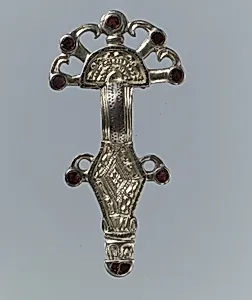
Medium
Silver-gilt, niello, garnets
Dimensions
Overall: 1 15/16 x 3 3/4 x 3/8 in. (4.9 x 9.5 x 1 cm)
Classification
Metalwork-Silver
Culture
Frankish
Department
Medieval Art
Museum
Metropolitan Museum of Art, New York, NY
Credit
Gift of J. Pierpont Morgan, 1917
Accession Number
17.191.172
Rights
Public Domain
Art Historical Context
This exquisite Bow Brooch, crafted by an unknown Frankish artisan around 500–550 CE, offers a glimpse into the opulent world of the Merovingian, who dominated much of early medieval Europe. Measuring just under 4 inches wide, this delicate metalwork clasp was likely used to secure a cloak or garment, a practical yet prestigious accessory for the elite. Housed in the Metropolitan Museum Art's Medieval Art departmentthanks to a 1917 gift from J Pierpont Morgan—it exemplifies the refined craftsmanship of Frankish jewelers during the Migration Period. Fashioned from silver-gilt, the brooch gleams with a thin gold overlay that enhances its luster, while intricate niello inlays— a technique using a black metallic alloy fired into engraved lines—create striking contrasts and fine details. Tiny garnets, cut and polished to catch the light, add vibrant red accents, a hallmark of high-status Germanic jewelry. These materials and methods highlight the technical sophistication of the era, blending Roman influences with emerging barbarian artistry. Culturally, such brooches symbolized wealth and status among Frankish nobility, often buried with their owners as grave goods. This piece not only fastened clothing but fastened us to a dynamic age of kingdoms rising from the ashes of Rome, inviting visitors to ponder the lives of those who wore it.