
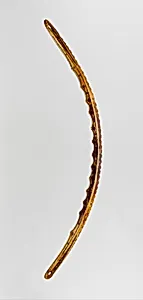
Bow Drill
Unknown Artist
10th century
Medium
Ivory (walrus)
Dimensions
H. 3/4 x W. 20 in. (2 x 50.8 cm)
Classification
Bone/Ivory-Implements
Culture
Punuk
Department
Arts of Africa, Oceania, and the Americas
Museum
Metropolitan Museum of Art, New York, NY
Credit
Purchase, The Houghton Foundation Inc. Gift, 1979
Accession Number
1979.410
Rights
Public Domain
Art Historical Context
Step into the ancient world of the Punuk people with this remarkable 10th-century bow drill, a masterful implement from the Bering Strait region of the Arctic. Crafted by an unknown artist from the Punuk culture—known for their seafaring prowess and close ties to marine life—this slender tool exemplifies the ingenuity of early Arctic societies. Measuring just 3/4 inch high and 20 inches long its compact form was designed for precision: the bow drill used a bowstring to rotate a shaft, creating holes in bone, ivory, or wood for crafting tools, jewelry, and hunting gear essential to survival in harsh environments. Carved from walrus ivory, a prized material among Punuk artisans, the drill highlights their exceptional skill in working tough, resilient substances sourced from the sea. Walrus ivory's durability and creamy sheen made it ideal for functional objects that doubled as subtle works of art, often adorned with incised patterns (though this example focuses on pure utility). This piece, acquired by The Metropolitan Museum of Art in 1979 through a generous gift, offers a window into Punuk daily life around 900–1000 CE, bridging technology and tradition in the Arts of Africa, Oceania, and the Americas collection. Today, it reminds us how everyday tools embodied cultural resilience, reflecting a people's harmony with nature and mastery over their materials.