
Bowcase and Quiver of Arrows
1438
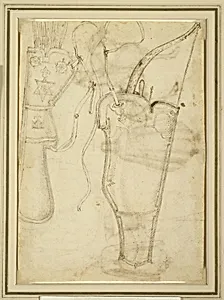
Medium
Pen and brown ink on ivory laid paper
Dimensions
18.9 × 26.5 cm (7 1/2 × 10 7/16 in.)
Classification
pen and ink drawings
Department
Prints and Drawings
Museum
Art Institute of Chicago
Accession Number
113569
Rights
Public Domain
Art Historical Context
Nestled in the Art Institute of Chicago's Prints Drawings collection, *Bowcase and Quiver of Arrows (1438) is a masterpiece by the Italian artist Pisanello (c. 1395–1455). Rendered in pen and brown ink on laid paper (18.9 × 26.5 cm), this drawing exemplifies Pisanello's extraordinary skill as one of the finest draftsmen of the early Renaissance. Working at the courts of Milan, Venice, and Naples, he bridged the ornate International Gothic style with emerging Renaissance naturalism, often capturing intricate details from nature and everyday objects with scientific precision. Pisanello's technique shines here through his masterful use of fine, fluid lines and subtle hatching to convey texture and form. The bowcase and quiver—likely inspired by hunting gear or ceremonial arms popular among Renaissance nobility—reveal his fascination with the tactile qualities of leather, metal fittings, and feathers. These studies were not mere sketches but autonomous works, valued for their lifelike observation, much like his renowned animal drawings. This piece offers a window into 15th-century Italian courtly life, where archery symbolized prowess and elegance. Its survival on laid paper underscores the era's growing appreciation for drawings as collectible art, influencing later masters like Leonardo da Vinci. Visitors will appreciate its quiet elegance, a testament to Pisanello's enduring legacy in elevating the humble sketch to high art.
About the Artist
Pisanello · 1395–1455
Antonio di Puccio Pisano, known as Pisanello (c. 1395–1455), was a pioneering Italian painter, draftsman, and medalist born in Pisa, though he spent his early years near Verona. His early training occurred in Verona under local painters, possibly Stefano da Verona or Altichiero, fostering a style rooted in Veronese traditions. Between 1415 and 1420, he served as assistant to Gentile da Fabriano, a...