
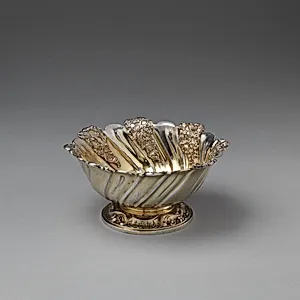
Bowl
1744/45
Medium
Silver-gilt
Dimensions
3 × 6 3/8 in. (7.6 × 16.2 cm)
Classification
Metalwork-Silver
Culture
British, London
Department
European Sculpture and Decorative Arts
Museum
Metropolitan Museum of Art, New York, NY
Credit
Gift of Irwin Untermyer, 1970
Accession Number
1970.131.33
Rights
Public Domain
Tags
Art Historical Context
This exquisite silver-gilt bowl, by George Wickes in1744/45, the refined artistry of mid-18th-century Britishversmithing from London. Wickes, a prominent goldsmith of his era, produced luxurious metalwork for the elite, and this piece bears his distinctive maker's mark. Measuring just 3 × 6 3/8 inches (7.6 × 16.2 cm), its compact form suggests it served as elegant tableware or a decorative centrepiece, perfect for intimate gatherings in Georgian households. The medium of silver-gilt—fine silver coated with a thin layer of gold via electroplating or fire-gilding—lent a radiant, jewel-like sheen that symbolized wealth and status. Adorned with a coat of arms, the bowl likely commemorated a family's heraldic lineage, a common practice among Britain's aristocracy during the Hanoverian period. Such pieces were not merely functional but status symbols, showcasing the silversmith's mastery of chasing, engraving, and gilding techniques. Today, this treasure resides in the Metropolitan Museum of Art's Department of European Sculpture and Decorative Arts, a gift of Irwin Untermyer in 1970. It offers a glimpse into the opulent world of 18th-century London society, where every gleam told a story of prestige and craftsmanship.