
Bowl
Unknown Artist
first half 14th century
Medium
Earthenware; painted on opaque white ground under transparent glaze
Dimensions
Diam. 6 3/4 in. (17.1 cm)
Classification
Ceramics
Department
Islamic Art
Museum
Metropolitan Museum of Art, New York, NY
Credit
Rogers Fund, 1910
Accession Number
10.44.5
Rights
Public Domain
Art Historical Context
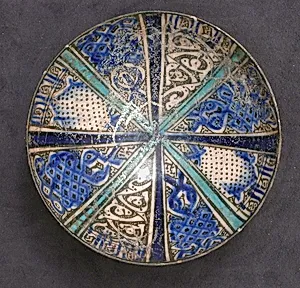
This small earthenware bowl displays a striking radial composition, its surface divided into eight triangular segments that radiate from the center. Alternating sections feature deep cobalt blue and creamy white grounds, accented by turquoise bands and intricate black motifs that include geometric knots, dotted patterns, and flowing calligraphic designs. The painting is executed on an opaque white ground beneath a transparent glaze, giving the surface a luminous yet slightly worn quality, with visible cracks and repairs that hint at its age. Created in the first half of the fourteenth century by an unknown artist, the bowl belongs to the Metropolitan Museum’s collection of Islamic Art. It exemplifies the refined ceramic traditions of that era, when potters skillfully combined bold color contrasts with delicate surface decoration to transform everyday objects into works of art. Acquired through the Rogers Fund in 1910, this piece invites viewers to appreciate the enduring beauty of its geometric harmony and the technical mastery of its underglaze technique.