
Bowl
Unknown Artist
13th century
Medium
Earthenware; underglaze painted
Dimensions
H. 3 7/8 in. (9.8 cm) Diam. 8 1/2 in. (21.6 cm) Wt. 12.6 oz. (357.2 g)
Classification
Ceramics
Department
Islamic Art
Museum
Metropolitan Museum of Art, New York, NY
Credit
Rogers Fund, 1912
Accession Number
12.49.2
Rights
Public Domain
Art Historical Context
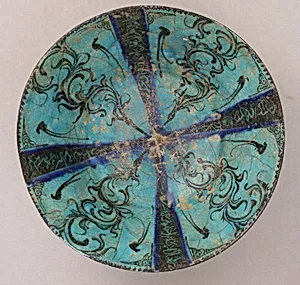
This shallow earthenware bowl, seen from above, displays a luminous turquoise glaze that covers its interior surface. The design radiates from the center in eight wedge-shaped sections, alternating between delicate black scrollwork and floral motifs with narrow bands of deep blue and black that contain fine inscriptions. The glaze shows a network of fine crackling, and the rim is accented with a simple dotted border. Created in the thirteenth century by an unknown artist, the bowl was made using the underglaze-painting technique, in which pigments were applied before the final glazing and firing. Now part of the Metropolitan Museum of Art’s collection of Islamic Art, it reflects the refined ceramic traditions of the period, when such vessels combined utility with intricate surface decoration. Its modest size and balanced composition invite close looking, revealing the skill involved in arranging pattern and script across a curved surface.