
Bowl
Unknown Artist
9th–10th century
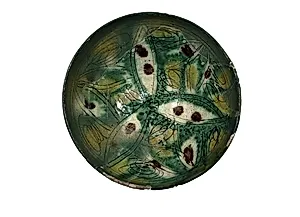
Medium
Earthenware; white slip, incised and splashed with polychrome glazes under transparent glaze (sgraffito ware)
Dimensions
H. 2 9/16 in. (6.5 cm) Diam. 7 in. (17.8 cm)
Classification
Ceramics
Department
Islamic Art
Museum
Metropolitan Museum of Art, New York, NY
Credit
Rogers Fund, 1938
Accession Number
38.40.127
Rights
Public Domain
Art Historical Context
This delicate earthenware bowl, crafted by an unknown artist in the 9th–10th, exemplifies the ingenuity of early Islamic ceramics from the Metropolitan Museum of Art's Islamic Art collection. Measuring just 2⅝ inches high and 7 inches in, its modest size belies its sophisticated design, making it a perfect vessel for daily use in a bustling medieval household—perhaps holding fruits, spices, or beverages during communal meals. The bowl's standout feature is its sgraffito technique, a masterful process where a white slip was applied over the earthenware body, then incised with intricate patterns to reveal the underlying clay. Vibrant polychrome glazes—splashed in hues of green, yellow, and manganese purple—were added before a transparent overglaze, creating a luminous, jewel-like effect upon firing. This innovative method, prominent in Abbasid-era workshops, marked a shift toward more expressive, colorful ceramics that blended functionality with artistry. Acquired through the Rogers Fund in 1938, this bowl highlights the cultural flourishing of the Islamic world, where pottery became a canvas for geometric motifs and rhythmic designs symbolizing harmony and abundance. Visitors can marvel at how such everyday objects embodied technical prowess and aesthetic refinement, bridging art and life in the medieval Near East.