
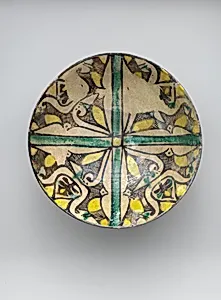
Buff Ware Bowl with Geometric Patterns
Unknown Artist
9th century
Medium
Earthenware; polychrome decoration under transparent glaze (buff ware)
Dimensions
H. 4 1/16 in. (10.3 cm) Diam. of rim: 10 1/4 in. (10.3 x 26 cm) Diam. of base: 4 5/16 in. (11 cm)
Classification
Ceramics
Department
Islamic Art
Museum
Metropolitan Museum of Art, New York, NY
Credit
Rogers Fund, 1939
Accession Number
39.40.68
Rights
Public Domain
Art Historical Context
This exquisite Buff Ware Bowl with Geometric Patterns, dating to the 9th, exemplifies the vibrant ceramic traditions of early Islamic art. Crafted earthenware, it features creamy buff body adorned with bold polychrome decoration—typically in shades of blue, green, and manganese purple—applied under a transparent glaze. just over 4 inches tall with a 10-inch rim diameter, this shallow bowl was likely used for serving fruits, sweets, or beverages in a prosperous household, reflecting the era's advancements in pottery production during the Abbasid Calate. The geometric motifs—interlacing stars, zigzags, and stylized vegetal forms—highlight the artist's mastery of symmetry and rhythm, core principles of Islamic design that evoke infinity and divine order while adhering to aniconic conventions avoiding human or animal figures. The innovative use of polychrome slips under a lead-based transparent glaze created a luminous, jewel-like sheen, a technique pioneered in Mesopotamian workshops around this time. This marked a shift from monochrome pottery, influencing later lusterware traditions across the Islamic world. Acquired through the Rogers Fund in 1939 and now in the Metropolitan Museum of Art's Islamic Art Department, this bowl offers a window into 9th-century cultural exchange along Silk Road trade routes, where such wares symbolized refinement and technical prowess. Visitors will appreciate its delicate scale and enduring elegance.