
Bowl
Unknown Artist
9th century
Medium
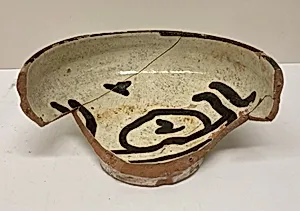
Earthenware; white slip with monochrome slip decoration under transparent glaze
Dimensions
H. 2 1/8 in. (5.4 cm) Diam. 5 1/8 in. (13 cm)
Classification
Ceramics
Department
Islamic Art
Museum
Metropolitan Museum of Art, New York, NY
Credit
Rogers Fund, 1938
Accession Number
38.40.167
Rights
Public Domain
Art Historical Context
This delicate 9th-century earthen bowl, standing just over 2 inches tall and5 inches wide, exemplifies the refined ceramics of the early Islamic world. Crafted an unknown artist, its white slip body features monochrome slip decoration—typically bold, abstract motifs or calligraphy—sealed beneath a transparent glaze that lends a subtle sheen and protects the surface. Such techniques emerged during the Abbasid Caliphate, transforming everyday vessels into objects of beauty and utility. The use of slip decoration under glaze was a hallmark innovation in Islamic pottery, allowing artisans to create intricate designs without relying on costly materials like porcelain, which was unavailable in the region. This bowl's modest scale suggests it served practical purposes in households, perhaps for serving sweets or beverages, while its elegant form reflects the era's emphasis on harmony and geometric precision in design. Housed in the Metropolitan Museum of Art's Islamic Art Department (acquired via the Rogers Fund in 1938), this piece offers a window into a golden age of craftsmanship, where ceramics bridged art and daily life, influencing traditions across the Middle East and beyond.