
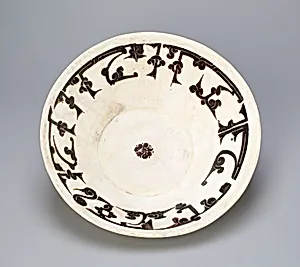
Bowl with Calligraphic Design
Samanid dynasty (819-1005), 10th century
Medium
Earthenware, white slip with black slip decoration under a transparent glaze
Dimensions
9 × 26.1 cm (3 3/8 × 10 1/4 in.); Diam.: 26.1 cm (10 1/4 in.)
Classification
bowl
Department
Arts of Asia
Museum
Art Institute of Chicago
Accession Number
217770
Rights
Public Domain
About this artwork
In the 10th and 11th centuries, a tradition of painting ceramics in thick colored slips (watered-down clay) became common practice in central and eastern Iran. These vessels were typically decorated with simple calligraphic lines, often containing blessings or pious insights, not unlike fortune cookie messages. Here the text reads, "[Generosity] is a disposition of the dwellers of Paradise... regret." This type of script is known as knotted Kufic, distinctive for its consistent baseline and embe...
About the Artist
Islamic
Islamic art, a profound visual tradition originating in the 7th century CE, flourished across vast territories from Spain to India under Muslim rule, encompassing architecture, ceramics, manuscripts, textiles, and metalwork produced by diverse artisans rather than a single named master. Drawing from pre-Islamic Sasanian, Byzantine, and late antique influences, its early development under the Umayy...