
Bowl
Unknown Artist
11th century
Medium
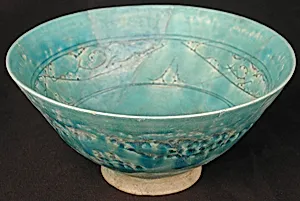
Earthenware; white slip under turquoise glaze, incised
Dimensions
H. 3 1/2 in. (8.9 cm) Diam. of rim: 7 1/4 in. (18.4 cm)
Classification
Ceramics
Department
Islamic Art
Museum
Metropolitan Museum of Art, New York, NY
Credit
Rogers Fund, 1938
Accession Number
38.40.188
Rights
Public Domain
Art Historical Context
This elegant 11th-century earthen bowl, standing just 3½ inches tall with a 7¼-inch rim diameter, exemplifies the refined ceramics of the Islamic world.ed by an unknown artist, it features white slip applied over the clay body, topped with a vibrant turquoise glaze—a hallmark of medieval Islamic pottery production. The incised decoration, carved into the slip before glazing, creates subtle textures and patterns that catch the light, showcasing the potter's skill in balancing form and surface treatment. Produced during a golden age of Islamic art, likely in regions like Persia or Central Asia under Seljuk influence, this bowl reflects advancements in ceramic technology. The turquoise glaze, derived from copper oxide, not only provided a stunning jewel-like color but also protected the vessel for everyday use, such as serving food or beverages. Incising allowed for intricate designs without the complexity of painting, making it accessible yet artistic. Housed in the Metropolitan Museum of Art's Islamic Art Department (acquired via the Rogers Fund in 1938), this modest bowl offers a window into daily life and aesthetic sensibilities of the medieval Islamic world, where beauty infused even utilitarian objects. Visitors will appreciate its timeless allure up close.