
Bowl
Unknown Artist
late 12th–early 13th century
Medium
Stonepaste; polychrome painted under transparent glaze
Dimensions
H. 4 1/8 in. (10.5 cm) Diam. 8 7/8 in. (22.5 cm)
Classification
Ceramics
Department
Islamic Art
Museum
Metropolitan Museum of Art, New York, NY
Credit
H.O. Havemeyer Collection, Gift of Horace Havemeyer, 1941
Accession Number
41.165.2
Rights
Public Domain
Art Historical Context
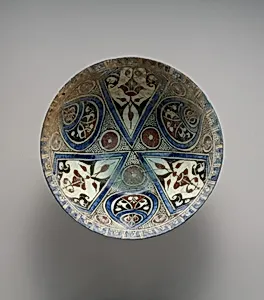
This bowl, seen from above, reveals a symmetrical interior design radiating from a small central medallion. Eight triangular and arched compartments alternate around the surface, filled with stylized flowers, curling leaves, and abstract motifs in deep blue, turquoise, reddish-brown, and black. These elements rest on white or pale grounds, enclosed by dotted borders and a narrow decorative band along the rim, all unified beneath a smooth, transparent glaze that enhances the stonepaste surface. Created in the late 12th to early 13th century by an unknown artist, the bowl demonstrates the refined ceramic techniques of Islamic art. The polychrome painting applied under the glaze allowed for lasting, vibrant colors while maintaining a luminous finish. Such works highlight the period’s emphasis on balanced geometry and natural forms, transforming everyday objects into expressions of visual harmony. Now part of the Metropolitan Museum of Art’s Islamic Art collection, this piece entered the museum as a gift from the H.O. Havemeyer Collection in 1941, preserving a fine example of medieval craftsmanship for modern viewers.