
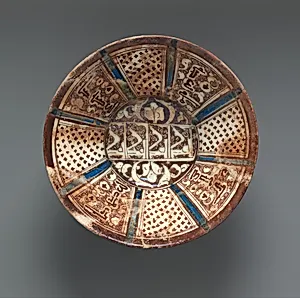
Ceramic Bowl Inscribed with "'Izz" ("Glory")
Unknown Artist
12th century
Medium
Stonepaste; underglaze-painted, glazed (transparent colorless), luster-painted
Dimensions
H. 4 11/16 in. (11.9 cm) Diam. 9 1/4 in. (23.5 cm) Wt. 18.8 oz. (533 g)
Classification
Ceramics
Department
Islamic Art
Museum
Metropolitan Museum of Art, New York, NY
Credit
H.O. Havemeyer Collection, Gift of Horace Havemeyer, 1948
Accession Number
48.113.6
Rights
Public Domain
Tags
Art Historical Context
This shallow ceramic bowl draws the eye with its radiating design, centered on a round medallion filled with geometric and stylized floral motifs. Eight wedge-shaped panels alternate between intricate Arabic calligraphy and dense patterns of small dots or latticework, all in warm brownish tones with touches of turquoise blue that accent the divisions. The surface carries the subtle metallic sheen of luster painting over a pale ground, creating a rich, reflective effect that catches the light. Created in the twelfth century from stonepaste and finished with underglaze and luster techniques, the bowl is inscribed with the Arabic word “‘Izz,” meaning “Glory.” Such vessels were prized in medieval Islamic societies for both their beauty and their auspicious messages. Today it stands as a fine example of the refined ceramic traditions preserved in the Metropolitan Museum’s collection, inviting visitors to appreciate the skill and meaning embedded in everyday objects of the period.