
Bowl
Unknown Artist
mid-12th century
Medium
Stonepaste; luster-painted on opaque white ground
Dimensions
H. 2 1/8 in. (5.4 cm) Diam. 8 11/16 in. (22.1 cm)
Classification
Ceramics
Department
Islamic Art
Museum
Metropolitan Museum of Art, New York, NY
Credit
H.O. Havemeyer Collection, Gift of Horace Havemeyer, 1941
Accession Number
41.199.5
Rights
Public Domain
Tags
Art Historical Context
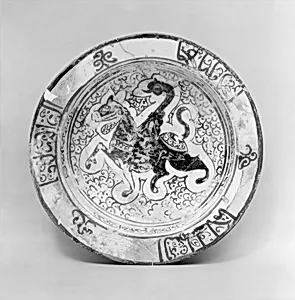
This elegant mid-12th-century from the Islamic world exemplifies the pinnacle of medieval ceramic artistry. Crafted during a golden age of Islamic culture, likely in Persia or Syria, it reflects the technical ingenuity of artisans who developed stonepaste—a composite body of quartz, clay, and frit—to mimic the translucency of porcelain, a material then prized from distant China. Measuring just over 8 inches in diameter and inches high, its shallow form was ideal for serving sweets, fruits, or beverages at opulent gatherings. The bowl's surface dazzles with luster-painting on an opaque white ground, a sophisticated technique where metallic oxides were applied over a tin glaze and fired in a reducing atmosphere to create a shimmering, iridescent gold effect. This luxury ware, reserved for the elite, often featured dynamic motifs like horses—energetic depictions symbolizing nobility, speed, and equestrian prowess in Islamic society. The horses here gallop vividly, capturing the vibrancy of daily life and courtly pursuits. Now housed in the Metropolitan Museum of Art's Islamic Art Department, gifted from the H.O. Havemeyer Collection in 1941, this bowl invites us to marvel at the fusion of science and beauty in 12th-century craftsmanship, bridging East and West through enduring elegance.