
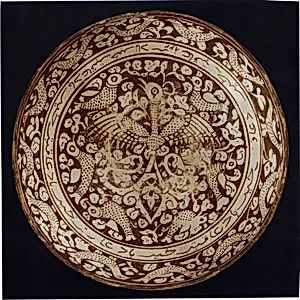
Bowl with Repeating Persian Inscription Wishing for Good Fortune
Unknown Artist
dated A.H. 822/ 1419–20 CE
Medium
Stonepaste; luster-painted on opaque white glaze
Dimensions
H. 4 7/8 in. (12.4 cm) Diam. 11 1/4 in. (28.6 cm)
Classification
Ceramics
Department
Islamic Art
Museum
Metropolitan Museum of Art, New York, NY
Credit
Purchase, Louis E. and Theresa S. Seley Purchase Fund for Islamic Art, and funds from various donors, 2005
Accession Number
2005.1
Rights
Public Domain
Tags
Art Historical Context
This exquisite bowl, crafted in 1419–20 CE (A.H. 822), hails from the Islamic world, likely Persia, where ceramics flourished as both functional art and symbols of prosperity. Made of stonepaste—a composite body of quartz, clay, and frit that mimics porcelain's translucency—the vessel features luster-painting over an opaque white glaze. labor-intensive technique applies metallic oxides, fired in a reducing atmosphere to create a shimmering, iridescent glow, evoking the luxury of gold without its weight. Measuring 4⅞ inches high and 11¼ inches in diameter, it's perfectly sized for communal dining or display. The bowl's surface repeats a Persian inscription wishing good fortune, a talismanic motif common in Islamic pottery to invoke blessings for owners and users. Delicate birds and leafy motifs dance around the rim and interior, blending naturalism with stylized elegance. Produced during the Timurid era's cultural renaissance, such wares highlight the era's mastery of color and shine, bridging utility and spirituality in everyday life. At the Metropolitan Museum of Art, this piece (acquired in 2005) exemplifies the enduring allure of lusterware, a technique pioneered in 9th-century Iraq and perfected in Iran, captivating collectors with its radiant beauty.