
Bowl
Unknown Artist
12th–13th century
Medium
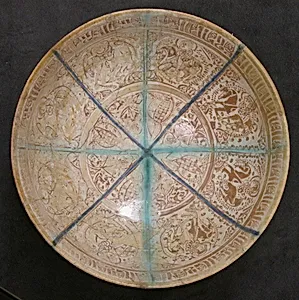
Stonepaste; glazed and luster-painted, turqoise and blue lines
Classification
Ceramics
Department
Islamic Art
Museum
Metropolitan Museum of Art, New York, NY
Credit
H.O. Havemeyer Collection, Gift of Horace Havemeyer, 1948
Accession Number
48.113.22
Rights
Public Domain
Tags
Art Historical Context
This exquisite stonepaste bowl, crafted in the 12th–13th century, exemplifies pinnacle of Islamic ceramic artistry from the medieval Islamic world, likely Persia or Syria. Fashioned from a composite body of quartz, clay, and frit—known as stonepaste or fritware—it was wheel-thrown, glazed for a smooth sheen, and adorned with intricate luster-painting in turquoise and cobalt blue lines. This labor-intensive technique, involving metallic oxides fired in a reducing atmosphere to create a shimmering iridescence, transformed everyday vessels into luxurious objects coveted by elites. The bowl's decoration, featuring dynamic scenes of men and horses, reflects the vibrant cultural motifs of the era, evoking equestrian pursuits, hunts, or polo games central to Islamic courtly life under dynasties like the Seljuks or early Ilkhanids. Such imagery celebrated human-animal harmony, prowess, and leisure, rendered with fluid lines that highlight the potters' mastery of stylized figuration. Part of the renowned H.O. Havemeyer Collection and gifted to the Metropolitan Museum of Art in 1948, this piece offers a window into the technological innovation and aesthetic refinement of Islamic artisans, bridging utility and opulence in a golden age of ceramics.