
Bowl
Unknown Artist
12th–13th century
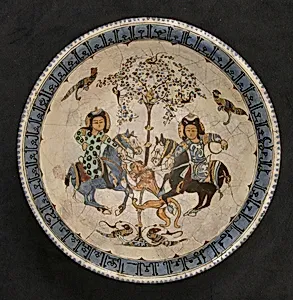
Medium
Stonepaste; overglaze painted, so-called "mina'i" ware
Dimensions
H. 3 9/16 in. (9 cm) Diam. 8 3/4 in. (22.2 cm)
Classification
Ceramics
Department
Islamic Art
Museum
Metropolitan Museum of Art, New York, NY
Credit
Purchase, Rogers Fund, and Gift of The Schiff Foundation, 1957
Accession Number
57.36.1
Rights
Public Domain
Tags
Art Historical Context
This elegant stonepaste bowl, crafted in the 12th–13th, exemplifies the pinnacle of Islamic ceramic artistry from medieval Persia, likely Kashan. Measuring just 3⅝ inches high and 8¾ inches in diameter, its shallow form was ideal for serving fruits, sweets, or beverages at elite banquets. Housed in the Metropolitan Museum of Art's Art Department (acquired in 1957 through the Rogers Fund and a gift from The Schiff Foundation), it showcases the technical innovation of "mina'i" ware—a luxurious technique where vibrant enamel colors, including blues, greens, and golds, were painted over a glazed surface and fired at low temperatures to achieve luminous, jewel-like effects. Mina'i ware, meaning "enamel-like" in Persian, was produced during a golden age of Seljuq patronage, when artisans pushed the boundaries of ceramics to rival costly metalwork and glass. This overglaze method allowed for intricate, multi-layered designs that captured movement and depth, marking a high point in Islamic pottery before techniques shifted in later centuries. The bowl's lively motifs—horses in motion, majestic lions, graceful birds, and human figures—evoke themes of the hunt, nature's power, and courtly life. These dynamic scenes reflect the cultural vibrancy of the era, blending realism with stylized elegance to delight and inspire viewers across centuries.