
Bowl
Unknown Artist
15th–16th century
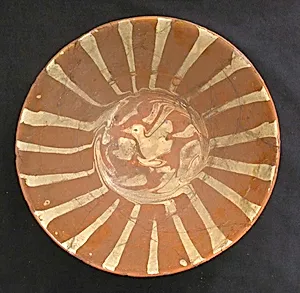
Medium
Earthenware; white slip, splashed and applied reddish brown glaze
Dimensions
H. 5 5/8 in. (14.3 cm) Diam. at mouth: 12 5/8 in. (32.1 cm) Wt. 42 oz. (1190.814 gr)
Classification
Ceramics
Department
Islamic Art
Museum
Metropolitan Museum of Art, New York, NY
Credit
Gift of Mr. and Mrs. Lester Wolfe, 1961
Accession Number
61.185.2
Rights
Public Domain
Tags
Art Historical Context
This elegant earthenware bowl, crafted by an unknown artist in the15th–16th, exemplifies the refined ceramic traditions of the Islamic world. just 5⅝ inches tall with a wide mouth diameter of 12⅝ inches, its generous form suggests it was designed for both practical use and display, perhaps holding fruits or sweets during communal meals. The bowl's surface is adorned with white slip—a liquid clay applied over the reddish-brown body—topped by splashed and meticulously applied reddish-brown glaze, creating dynamic patterns that catch the light. The technique of slip decoration and glaze splashing was a hallmark of Islamic pottery during this vibrant era, allowing artisans to achieve bold, abstract designs without relying on costly materials like metal or glass. Motifs of birds, hinted at in the tagging, likely evoke themes of freedom and nature, common in Persian or Ottoman ceramics, blending functionality with poetic artistry. These bowls were prized in households and courts, reflecting a culture that celebrated everyday beauty. Generously gifted to the Metropolitan Museum of Art by Mr. and Mrs. Lester Wolfe in 1961, this piece invites visitors to appreciate the ingenuity of anonymous makers whose work endures as a testament to Islamic ceramic innovation.