
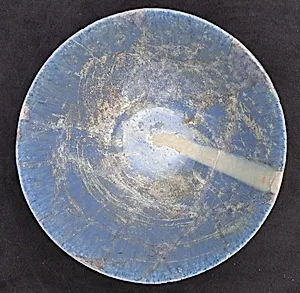
Bowl
Unknown Artist
12th century
Medium
Composite body; glazed
Dimensions
H. 3 1/4 in. (8.4 cm) Diam. 7 1/2 in. (19 cm)
Classification
Ceramics
Department
Islamic Art
Museum
Metropolitan Museum of Art, New York, NY
Credit
Gift of Mena Rokhsar, in memory of Ebrahim Khalil Rokhsar, 1995
Accession Number
1995.512.3
Rights
Public Domain
Art Historical Context
This elegant 12th-century bowl from the Islamic Art collection at the Metropolitan Museum of Art the refined ceramic traditions of the medieval Islamic world. Crafted a composite body—a mixture of quartz, clay, and frit (glass powder)—and finished with a glossy glaze, it measures just 3¼ inches high and 7½ inches diameter, making it a perfect example of functional yet sophisticated tableware. The composite technique, pioneered in the 10th-11th centuries in regions like Iran and Syria, allowed potters to create durable, porcelain-like vessels that could withstand daily use while enabling intricate surface decorations (though specifics here are not preserved). In the 12th century, during the height of Seljuk influence, such glazed ceramics were prized for their technical innovation and aesthetic appeal, often serving as status symbols in affluent households. The glazing process not only sealed the porous body but also provided a luminous surface ideal for vibrant colors and motifs inspired by nature or geometry—hallmarks of Islamic art's aversion to figurative representation in sacred contexts. Generously gifted in 1995 by Mena Rokhsar in memory of Ebrahim Khalil Rokhsar, this bowl invites us to appreciate the anonymous artisans whose mastery bridged utility and beauty, offering a tangible link to the vibrant cultural exchanges of the medieval Islamic world.