
Bowl
Unknown Artist
12th century
Medium
Earthenware; carved and glazed
Dimensions
H. 4 5/8 in. (11.8 cm) Diam. 9 3/16 in. (23.3 cm) Wt. 32.9 oz. (932.8 g)
Classification
Ceramics
Department
Islamic Art
Museum
Metropolitan Museum of Art, New York, NY
Credit
Gift of Ralph D. Minasian, 2001
Accession Number
2001.438.1
Rights
Public Domain
Art Historical Context
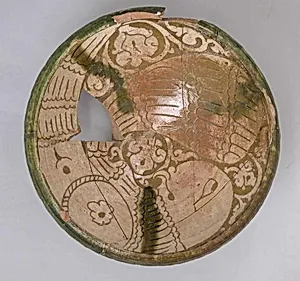
This elegant 12th-century earthen bowl, hailing from the Islamic world, exemplifies the refined craftsmanship of medieval Islamic ceramics. Standing just 4⅝ inches tall with a diameter of over 9 inches, its sturdy form (weighing nearly 33 ounces) suggests it was for practical use—likely holding food or drink in a bustling household. Now housed in the Metropolitan Museum of Art's of Islamic Art, it was generously gifted by Ralph D. Minasian in 2001. The bowl's medium highlights innovative techniques of the era: earthenware body carved with intricate designs and coated in a glossy glaze. Carving, often a sgraffito method where motifs are incised through a slip layer to reveal the clay beneath, created dynamic contrasts once fired under the translucent glaze. This labor-intensive process transformed everyday objects into artistic treasures, blending utility with aesthetic appeal—a hallmark of Islamic pottery production in regions like Persia (modern Iran) during the Seljuk period. Culturally, such bowls reflect the Islamic emphasis on beauty in the domestic sphere, where potters elevated simple forms through skilled decoration. Though the artist remains unknown, this piece survives as a testament to anonymous mastery, inviting us to appreciate the ingenuity of 12th-century artisans.