
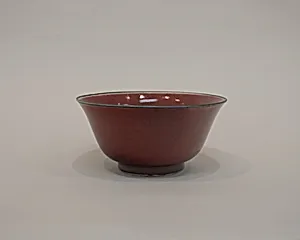
Bowl
Unknown Artist
late 17th–early 18th century
Medium
Porcelain with copper red glaze (Jingdezhen ware)
Dimensions
H. 4 in. (10.2 cm); W. 8 in. (20.3 cm); Diam. of rim: 8 in. (20.3 cm); Diam. of foot: 3 1/2 in. (8.9 cm)
Classification
Ceramics
Culture & Period
China · Qing dynasty (1644–1911), Kangxi period (1662–1722)
Department
Asian Art
Museum
Metropolitan Museum of Art, New York, NY
Credit
Bequest of Benjamin Altman, 1913
Accession Number
14.40.40
Rights
Public Domain
Art Historical Context
This exquisite porcelain bowl, crafted in Jingdezhen—the renowned "porcelain capital of China—dates to the late 17th or early 18th century the Kangxi period (1662–1722) of the Qing dynasty. Measuring 4 inches high with an 8-inch rim diameter, its simple yet elegant form exemplifies the refined utility of Kangxi ceramics, often produced for imperial courts or elite households. Jingdezhen wares like this were prized globally, symbolizing China's mastery of porcelain export during a golden age of artistic innovation. The bowl's standout feature is its copper red glaze, a technically demanding technique revived under Emperor Kangxi after earlier Ming dynasty experiments. Achieving the glaze's signature deep crimson hue—known as *sang de bœuf* or "oxblood"—required precise control of copper oxide in the kiln's reducing atmosphere, where even slight variations could yield unwanted greens or blacks. This rarity made such pieces emblems of virtuosity, blending functionality with aesthetic splendor. Now in the Metropolitan Museum of Art's Asian Art collection, thanks to the 1913 bequest of collector Benjamin Altman, the bowl invites visitors to appreciate the Qing era's fusion of tradition and technical brilliance, a testament to porcelain's enduring cultural prestige.