
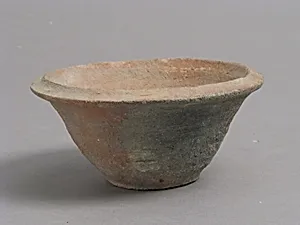
Bowl
Unknown Artist
4th–7th century
Medium
Earthenware
Dimensions
Overall: 2 1/4 x 4 1/2 in. (5.7 x 11.4 cm)
Classification
Ceramics
Culture
Coptic
Department
Medieval Art
Museum
Metropolitan Museum of Art, New York, NY
Credit
Rogers Fund, 1925
Accession Number
25.10.20.286
Rights
Public Domain
Tags
Art Historical Context
This modest earthenware bowl, crafted by an unknown Coptic artisan between the 4th and 7th centuries, offers a glimpse into everyday life in early Christian Egypt. Measuring just 2¼ x 4½ inches, it exemplifies the practical ceramics produced in Coptic workshops, where low-fired clay was shaped on a wheel or by hand and fired in simple kilns. Earthenware, prized for its affordability and durability, was a staple of domestic households, used for serving food or storing goods amid the Nile Valley's bustling communities. Coptic culture, blending ancient Egyptian traditions with emerging Christian influences during late antiquity, flourished under Roman and Byzantine rule. This period marked Egypt's shift toward monasticism and vibrant church art, yet humble objects like this bowl highlight continuity in utilitarian crafts. Though undecorated, its form reflects technical skill honed over millennia, underscoring the Copts' resourcefulness in a resource-scarce environment. Acquired through the Rogers Fund in 1925 and housed in The Metropolitan Museum of Art's Medieval Art Department, this bowl invites us to appreciate the unsung artistry of ancient daily routines—reminding visitors that history's grand narratives often rest in such simple vessels.