
Bowl
Unknown Artist
1800–1830
Medium
Blown pattern-molded lead glass
Dimensions
H. 5 3/8 in. (13.7 cm)
Classification
Bowl
Culture
American
Department
The American Wing
Museum
Metropolitan Museum of Art, New York, NY
Credit
Gift of Frederick W. Hunter, 1913
Accession Number
13.179.44
Rights
Public Domain
Art Historical Context
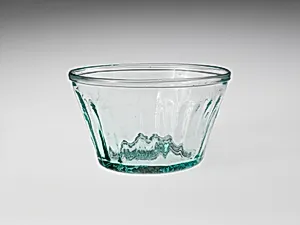
This elegant bowl, crafted by an unknown American artist between 1800 and 1830, exemplifies the ingenuity of early 19th American glassmaking. Standing at just 5⅜ inches (13.7 cm) tall, it was made from blown pattern-molded lead glass technique where molten glass was blown into a mold etched with intricate patterns, creating textured surfaces that catch the light beautifully. Lead glass, prized for its clarity and sparkle akin to European crystal, marked a sophisticated advancement in American production during a time when the young nation was building its own manufacturing traditions post-Revolution. Housed in The Metropolitan Museum of Art's American Wing, this bowl highlights the everyday artistry of the period. Glasshouses in regions like New England and Pennsylvania popularized pattern-molding in the early 1800s, blending utility with decoration for tableware used in middle-class homes. Donated in 1913 by Frederick W. Hunter, it serves as a window into America's emerging industrial creativity, where functional objects doubled as subtle status symbols. Though the maker remains anonymous, the bowl's survival underscores the durability and appeal of these handmade treasures, inviting us to appreciate the skilled hands behind America's decorative arts heritage.