
Bowl Fragment
Late 1st century BCE-mid–1st century CE
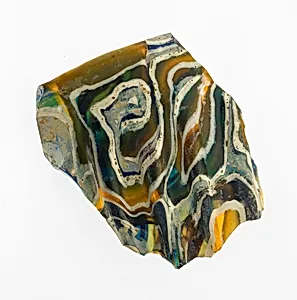
Medium
Glass, mosaic glass technique
Dimensions
7 × 6.4 × 2.1 cm (2 3/4 × 2 1/2 × 7/8 in.)
Classification
fragment
Department
Arts of Greece, Rome, and Byzantium
Museum
Art Institute of Chicago
Accession Number
67597
Rights
Public Domain
About this artwork
In ancient Rome, there was a high demand for colorful glass that could dazzle banquet guests alongside the expensive silver and gold serving wares meant to impress. Fragments like this one would have once been a part of larger mosaic dishes. The mosaic pattern was made by sagging molten glass into bowl-shaped molds, a technique used on many of these fragments is similar to millefiori, “thousand flowers” in Italian, a modern glass-making method in which tiny rods of colored glass are bundled toge...
Art Historical Context
This delicate bowl fragment, crafted by ancient Roman artisans between the late 1st BCE and mid-1st century CE, exemplifies the of early Imperial glassmaking. Measuring just 7 × 6.4 × 2.1 cm, it is a surviving piece of what was likely a elegant table vessel, now housed in the Art Institute of's Department of Arts of Greece, Rome, Byzantium. The standout feature is its mosaic glass technique, a sophisticated Roman innovation where slender rods of colored glass were bundled, fused, and sliced to create intricate, floral-like patterns resembling millefiori. This labor-intensive method produced vibrant, jewel-toned effects that mimicked more precious materials like gemstones or enamels, making such bowls prized luxury items for elite dining. As a testament to Rome's technological prowess during its transition from Republic to Empire, this fragment highlights how glass evolved from everyday utility to high art. Though incomplete, it invites us to imagine the opulent banquets where it once gleamed, underscoring the cultural value Romans placed on beauty in the everyday.
About the Artist
Ancient Roman
The artists attributed to "Ancient Roman" in museum collections represent the anonymous craftsmen who produced the vast output of sculpture, frescoes, mosaics, and reliefs defining Roman visual culture from the Republic (c. 509–27 BCE) to the late Empire (c. 395 CE). Individual identities remain elusive, as Roman makers were typically viewed as skilled tradesmen—often enslaved Greeks or provincial...