
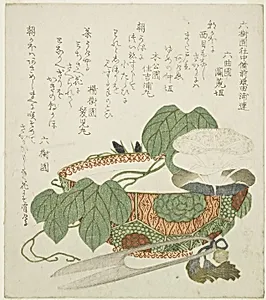
Bowl, scissors, and morning glories
c. 1820
Medium
Color woodblock print; shikishiban, surimono
Dimensions
22 × 20.6 cm (8 11/16 × 8 1/8 in.)
Classification
woodblock print
Department
Arts of Asia
Museum
Art Institute of Chicago
Accession Number
81583
Rights
Public Domain
Art Historical Context
Yashima Gakutei's *Bowl, Scissors, and Morning Glories*c. 1820) is a captivating example of Japanese surimono, a deluxe genre of color woodblock print produced privately for poetry circles, New Year's greetings, or special occasions. Rendered in the intimate shikishiban formatmeasuring just 22 × 20.6 cm—this square composition exemplifies the refined artistry of the late Edo period (1603–1868). Gakutei, a ukiyo-e master known for his precise lines and subtle color harmonies, often blended poetry with visual elegance, making surimono like this one prized collector's items. The print's still-life subject—a humble bowl, scissors, and blooming morning glories—captures the poetic beauty of everyday objects, a hallmark of Japanese aesthetics emphasizing transience (mono no aware). Crafted through meticulous woodblock techniques, including hand-applied pigments, embossing, and sometimes mica for a shimmering effect, it showcases the technical virtuosity of surimono over mass-produced ukiyo-e. Morning glories, symbolizing fleeting summer beauty, likely evoke a haiku inscribed nearby, inviting contemplation. Housed in the Art Institute of Chicago's Arts of Asia collection, this work highlights surimono's cultural role in fostering literati communities, bridging art and poetry in a time of strict censorship on commercial prints. A gem of understated luxury, it invites visitors to savor the quiet poetry in simplicity.
About the Artist
Yashima Gakutei · 1786–1868
Yashima Gakutei (c. 1786–1868), born in Osaka as the illegitimate son of a Tokugawa shogunate samurai named Hirata, adopted the name from his mother's subsequent marriage into the Yashima clan. Little is documented about his early years beyond these familial ties, but he pursued artistic training under the esteemed ukiyo-e masters Totoya Hokkei and Katsushika Hokusai, absorbing their precision in ...