
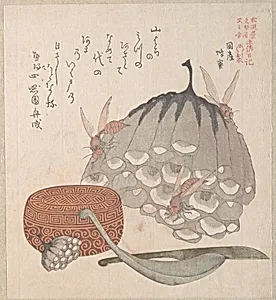
Hives with Wasps, and a Box with a Spoon for Honey
19th century
Medium
Woodblock print (surimono); ink and color on paper
Dimensions
8 x 7 3/16 in. (20.3 x 18.3 cm)
Classification
Prints
Culture & Period
Japan · Edo period (1615–1868)
Department
Asian Art
Museum
Metropolitan Museum of Art, New York, NY
Credit
H. O. Havemeyer Collection, Bequest of Mrs. H. O. Havemeyer, 1929
Accession Number
JP2083
Rights
Public Domain
Tags
Art Historical Context
Kubo Shunman's *Hives with Wasps and a Box with a for Honey* (19th century) is a delicate woodblock printsurimono), measuring just 8 x 7 3/16 inches, showcasing the artist's mastery in the ukiyo-e tradition of Edo-period Japan (1615–1868). This intimate scene captures beehives buzzing with wasps alongside a simple wooden box holding a honey spoon, rendered in vibrant inks and colors on paper. Shunman, a versatile poet and printmaker, often infused his works with playful observations of nature, blending realism with subtle whimsy. Surimono were luxurious, privately commissioned prints, typically produced for elite poetry gatherings or New Year's celebrations, distinguished by their small scale, fine craftsmanship, and sometimes extravagant techniques like embossing or mica dusting. Here, the meticulous carving of woodblocks allowed for rich textures—the translucent wings of wasps, the sticky gleam of honey—evoking everyday wonders amid Japan's urbanizing society. Insects, a favored motif in Japanese art, symbolized transience and the beauty of the ephemeral, aligning with Edo aesthetics. Part of the Metropolitan Museum of Art's H. O. Havemeyer Collection (1929), this print invites visitors to appreciate how Shunman elevated humble subjects into poetic treasures, bridging art, nature, and cultural ritual.
About the Artist
Kubo Shunman · 1757–1820
Japanese, 1757–1820