
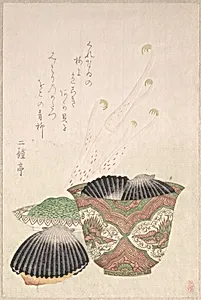
Bowl with Black Shells and Udo Plant
18th–19th century
Medium
Woodblock print (surimono); ink and color on paper
Dimensions
8 5/16 x 5 1/2 in. (21.1 x 14 cm)
Classification
Prints
Culture & Period
Japan · Edo period (1615–1868)
Department
Asian Art
Museum
Metropolitan Museum of Art, New York, NY
Credit
H. O. Havemeyer Collection, Bequest of Mrs. H. O. Havemeyer, 1929
Accession Number
JP2182
Rights
Public Domain
Tags
Art Historical Context
This delicate woodblock print, titledBowl with Black Shell and Udo Plant*, the quiet beauty of everyday Japanese fare from Japan's Edo period (16151868). Created by unidentified artist in the th–19th century it depicts a simple ceramic bowl brimming with glossy black shells—likely shellfish—and stalks of udo, a crisp mountain vegetable prized in Japanese cuisine for its subtle, asparagus-like flavor. Rendered in vibrant ink and color on paper the small format (just 8 5/16 x 5 1/2 inches) invites intimate contemplation, much like a personal gift or seasonal greeting. As a *surimono*, this print belongs to a refined genre of privately commissioned woodblock prints, often produced for New Year's celebrations, poetry gatherings, or announcements among elite circles. Unlike mass-produced ukiyo-e, *surimono* featured superior craftsmanship, with meticulous color layering, subtle gradients, and sometimes metallic accents to evoke luxury and transience. Here, the artist's keen eye for texture—the ridged shells, fibrous udo, and subtle sheen of the bowl—highlights Edo Japan's fascination with *mujo* (impermanence) and the artistry of the mundane, turning humble ingredients into poetic emblems of nature's bounty. Now in the Metropolitan Museum of Art's Asian Art collection (H. O. Havemeyer Collection, 1929), this piece offers a window into a cultured society's delight in food as art, blending culinary tradition with printmaking mastery.