
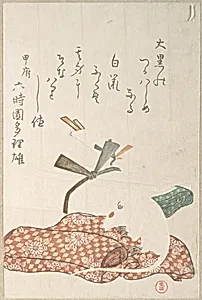
White Rat and Bundles of Cloth
probably 1816
Medium
Woodblock print (surimono); ink and color on paper
Dimensions
8 1/4 x 5 3/8 in. (21 x 13.7 cm)
Classification
Prints
Culture & Period
Japan · Edo period (1615–1868)
Department
Asian Art
Museum
Metropolitan Museum of Art, New York, NY
Credit
H. O. Havemeyer Collection, Bequest of Mrs. H. O. Havemeyer, 1929
Accession Number
JP2179
Rights
Public Domain
Tags
Art Historical Context
Kubo Shunman's *White and Bundles of Cloth* (ca. 1816) is delightful surimonoblock print from Japan's Edo period (5–1868), a time when ukiyo artists captured the floating world's whimsy and elegance. Shunman a master of this intimate genre, created surimono—priv commissioned prints often exchanged among poetry for New Year's greetings or. This small gem, measuring just 8¼ x 5⅜ inches, a pristine white rat perched amid folded bundles of cloth, blending everyday with poetic subtlety. The of ink and color on paper highlights ukiyo-e's innovative: multiple woodblocks for vibrant layering, precise registration, and subtle gradients (bokashi). Surimono like this one were luxurious, sometimes featuring embossing or metallic pigments for tactile allure, making them prized keepsakes for literati. Textiles evoke Japan's thriving silk trade and domestic life, while the rat—playful and symbolic in East Asian lore—adds a touch of humor and zodiac charm, as 1816 aligned with the Year of the Rat. Housed in the Metropolitan Museum of Art's H.O. Havemeyer Collection, this print exemplifies Edo Japan's fusion of art, poetry, and social ritual, inviting viewers to ponder the quiet poetry in ordinary scenes.
About the Artist
Kubo Shunman · 1757–1820
Japanese, 1757–1820