
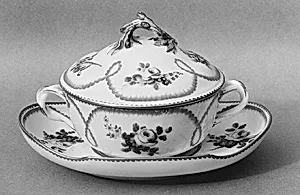
Bowl with cover (écuelle) and tray
Medium
Soft-paste porcelain
Dimensions
Height (écuelle [.149a, b]): 4 in. (10.2 cm); Width (tray [.150]): 7 1/8 in. (18.1 cm)
Classification
Ceramics-Porcelain
Culture
French, Sèvres
Department
European Sculpture and Decorative Arts
Museum
Metropolitan Museum of Art, New York, NY
Credit
Gift of R. Thornton Wilson, in memory of Florence Ellsworth Wilson, 1950
Accession Number
50.211.149a, b, .150
Rights
Public Domain
Tags
Art Historical Context
This elegant *Bowl with cover (éc) and tray*, crafted the renowned Sèvres Manuf in 1764, exemplifies the pinnacle of French porcelain artistry during the Louis XV era. Produced at the royal factory in Sèvres, near Versailles, this soft-paste porcelain set—standing just 4 inches tall for the lidded bowl and featuring a 7⅛-inch-wide tray—was designed for intimate dining rituals among the aristocracy. The écuelle, a small covered bowl traditionally used for soups or porridges, paired with its matching tray, reflects the opulent tableware that graced royal banquets and noble households. Sèvres' mastery of soft-paste porcelain, a French innovation blending clay, glass frit, and white ash, allowed for vibrant colors and intricate gilding that hard-paste varieties couldn't match at the time. Likely adorned with delicate rose motifs—a hallmark of Rococo floral exuberance—this piece showcases the manufactory's technical prowess in painting and firing, achieving a luminous translucency prized by collectors. Its creation in 1764 places it amid France's porcelain boom, as Sèvres vied with Meissen and Chinese imports for supremacy in luxury ceramics. Today, housed in The Metropolitan Museum of Art as a gift from R. Thornton Wilson, this trésor highlights the cultural prestige of Sèvres wares, symbols of refinement that blended artistry with royal patronage, inviting us to savor the sophistication of 18th-century French elegance.
About the Artist
Sèvres Manufactory · 1740–present
The Sèvres Manufactory, one of Europe's premier porcelain producers, was established in 1740 as the Manufacture de Vincennes under the patronage of Queen Marie Leszczyńska, who sought to rival Meissen and Chantilly porcelains with French soft-paste innovations. Initially a private venture, it relocated to Sèvres in 1756 in a purpose-built facility designed by architect Laurent Lindet near Madame d...