
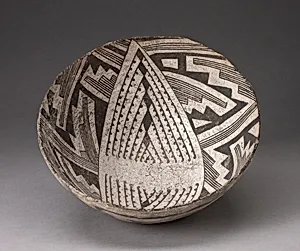
Bowl with Large Diamond-Shaped Area Interior with Dotted Lines and Diamonds, and Interlocking Stepped Motifs
950–1400
Medium
Ceramic and pigment
Dimensions
12.7 × 22.9 cm (5 × 9 in.)
Classification
bowl
Department
Arts of the Americas
Museum
Art Institute of Chicago
Accession Number
205
Rights
Public Domain
Art Historical Context
This exquisite ceramic bowl, crafted by the Ancestral Pueblo people (often referred to as Anasazi) between 950 and 1400 CE, the sophisticated pottery traditions of the ancient Southwest United States. Measuring just 5 × 9 inches, it was likely used for daily rituals or communal feasting in pueblo villages across the Four Corners region, where these communities thrived in arid landscapes, building cliff dwellings and kivas. The bowl's interior features a striking large diamond-shaped central area adorned with dotted lines and smaller diamonds, framed by interlocking stepped motifs on the exterior—hallmarks of Ancestral Pueblo geometric abstraction. Made from fired clay and pigmented with mineral slips, the designs were meticulously hand-painted before firing, showcasing the artists' mastery of fine-line techniques. These patterns, possibly evoking water, clouds, or clan symbols, reflect a worldview deeply connected to nature and cosmology. Housed in the Art Institute of Chicago's Arts of the Americas collection, this vessel highlights the Ancestral Pueblo's enduring legacy in American ceramics, bridging utility and artistry in a pre-Columbian world. Visitors are invited to imagine it filled with cornmeal, echoing the vibrant cultural life of these innovative ancestors.