
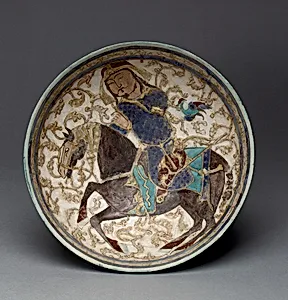
Bowl with Prince on Horseback
Unknown Artist
12th–13th century
Medium
Stonepaste; applied decoration, polychrome inglaze and overglaze painted and gilded on opaque monochrome glaze (mina'i)
Dimensions
H. 3 1/2 in. (8.9 cm) Diam. 8 9/16 in. (21.7cm)
Classification
Ceramics
Department
Islamic Art
Museum
Metropolitan Museum of Art, New York, NY
Credit
Harris Brisbane Dick Fund, 1951
Accession Number
51.53
Rights
Public Domain
Tags
Art Historical Context
Behold the exquisite *Bowl with Prince on Horseback*, gem from the 12th13th century Islamic world, now gracing the Metropolitan Museum of's Islamic Art department.ed by an unknown artist, this shallow stonepaste bowl (H. 3½ in., Diam. 8⅞ in.) captures a noble prince astride a galloping steed, evoking the era's fascination with equestrian prowess and princely splendor. Such motifs celebrated the mobility and status of elite horsemen in Persianate courts, blending daily life with artistic idealization. What sets this piece apart is its masterful mina'i technique—a pinnacle of medieval ceramic innovation. Artisans applied vibrant polychrome paints and gold both under and over an opaque monochrome glaze, fired at low temperatures to achieve luminous, jewel-like effects. This overglaze enameling, rare and labor-intensive, transformed humble bowls into luxurious objects fit for the wealthy, rivaling metalwork or illuminated manuscripts in opulence. Produced likely in Iran during the Seljuk period, the bowl reflects a golden age of Islamic ceramics, where technical virtuosity met storytelling. Acquired through the Harris Brisbane Dick Fund in 1951, it invites us to ponder the refined tastes of a bygone elite, where even a simple vessel became a canvas for cultural pride.