
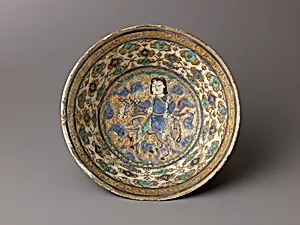
Bowl, Mina'i ("enameled") ware
Unknown Artist
early 13th century
Medium
Mina'i ware. Composite body, stain- and overglaze-painted, and gilded.
Dimensions
Diameter: 11 3/4 in. (30 cm.)
Classification
Ceramics-Pottery
Culture
Iranian
Department
Robert Lehman Collection
Museum
Metropolitan Museum of Art, New York, NY
Credit
Robert Lehman Collection, 1975
Accession Number
1975.1.1640
Rights
Public Domain
Tags
Art Historical Context
This exquisite Mina'i ware bowl, crafted in early 13th-century Iran exemplifies the pinnacle of Seljuk-era ceramic artistry. Measuring 11 3/4 inches in diameter, it hails from the Robert Lehman Collection at the Metropolitan Museum of Art The bowl's surface bursts with dynamic scenes of men and horses, capturing the energy of equestrian life—a motif evoking the nomadic heritage and martial prowess of Persian culture during the Islamic Golden Age. Mina'i ware, often called "enameled" pottery, represents a sophisticated composite technique: a frit body painted with stains under the glaze, enriched by overglaze colors and gold leaf applied after the initial firing. This required multiple kiln firings at low temperatures, allowing delicate enamels and gilding to fuse without cracking. Such innovation mimicked costly metalwork, making luxury accessible through clay and transforming everyday vessels into treasures. As a rare survivor of its kind, this bowl highlights Iran's role as a crossroads of artistic exchange, blending Central Asian, Chinese, and Islamic influences. Visitors can marvel at how these gilded riders still gallop across time, offering a window into a world where pottery rivaled the opulence of royal courts.