
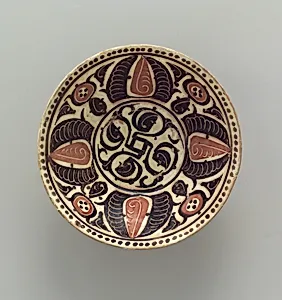
Bowl with Red and Purplish-black Palmettes
Unknown Artist
10th–11th century
Medium
Earthenware; white slip with polychrome slip decoration under transparent glaze
Dimensions
H. 2 1/2 in. (6.4 cm) Diam. of rim: 7 15/16 in. (20.2 cm)
Classification
Ceramics
Department
Islamic Art
Museum
Metropolitan Museum of Art, New York, NY
Credit
Gift of Charles K. Wilkinson, 1980
Accession Number
1980.540
Rights
Public Domain
Art Historical Context
This delicate earthenware bowl, titled *Bowl with Red and Purpl-black Palmettes*,ails from the 10th–11th and exemplifies the vibrant ceramic traditions of the Islamic world. Measuring just 2½ inches high with a rim diameter of nearly 8 inches, it likely used for serving food or drink in a household setting, blending everyday utility with artistic elegance. Crafted in the Metropolitan Museum of Art Islamic Art collection, it a period of cultural flourishing across Persia and Central Asia, where pottery became a canvas for intricate designs. The bowl's standout feature is its white slip base, adorned with bold polychrome slip decoration in red and purplish-black hues, all sealed under a transparent glaze that lends a glossy sheen. This technique—applying colored slips before firing—allowed artisans to achieve vivid, durable patterns without relying on costly metals like gold. The palmette motifs, stylized palm leaves radiating in rhythmic bands, evoke the organic forms beloved in Islamic decoration, symbolizing growth and beauty while adhering to aniconic principles that favored abstract and floral themes. As a gift to the Met in 1980, this piece offers a window into medieval Islamic craftsmanship, where humble bowls doubled as portable artworks. Visitors will appreciate its preserved vibrancy, a testament to the skill of anonymous potters whose innovations influenced ceramics far beyond their time.