
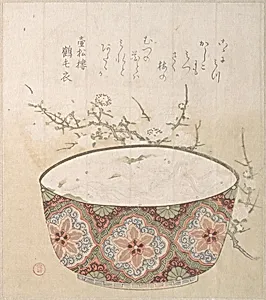
Bowl with White-Baits and Plum Blossoms
19th century
Medium
Woodblock print (surimono); ink and color on paper
Dimensions
8 3/16 x 7 1/4 in. (20.8 x 18.4 cm)
Classification
Prints
Culture
Japan
Department
Asian Art
Museum
Metropolitan Museum of Art, New York, NY
Credit
H. O. Havemeyer Collection, Bequest of Mrs. H. O. Havemeyer, 1929
Accession Number
JP2157
Rights
Public Domain
Tags
Art Historical Context
Kubo Shunman’s *Bowl with Whiteaits and Plum Bloss* is a delicate 19th-century woodblock print from Japan, exemplifying the refined art of *surimono*. These privately commissioned prints were luxurious New Year’s greetings or celebratory tokens for elite patrons, often featuring embossed textures, metallic pigments, and poetic inscriptions. Measuring just 8 3/16 x 7 1/4 inches, this intimate ink-and-color work on paper captures a serene still life: shimmering white-bait fish in a bowl alongside early-blooming plum blossoms evoking winter’s quiet beauty. In Japanese culture, plum blossoms symbolize resilience and renewal, heralding spring amid snow, while fresh fish like white-baits represent abundance and seasonal freshness. Shunman, a master of the ukiyo-e tradition, skillfully layered colors and subtle gradients to mimic the glossy sheen of water and petals, showcasing the woodblock technique’s precision—carved blocks inked by hand for each hue. This piece reflects Edo-period (1603–1868) aesthetics, blending everyday motifs with poetic elegance. Now in the Metropolitan Museum of Art’s H. O. Havemeyer Collection, it invites visitors to appreciate how *surimono* bridged art and social ritual, turning ephemeral greetings into enduring treasures.
About the Artist
Kubo Shunman · 1757–1820
Japanese, 1757–1820