
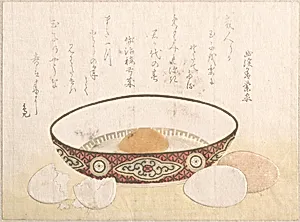
Flat Bowl with Eggs
probably 1813
Medium
Woodblock print (surimono); ink and color on paper
Dimensions
5 5/8 x 7 11/16 in. (14.3 x 19.5 cm)
Classification
Prints
Culture & Period
Japan · Edo period (1615–1868)
Department
Asian Art
Museum
Metropolitan Museum of Art, New York, NY
Credit
H. O. Havemeyer Collection, Bequest of Mrs. H. O. Havemeyer, 1929
Accession Number
JP2169
Rights
Public Domain
Tags
Art Historical Context
This delicate woodblock print, *Flat Bowl with Eggs*, by an unidentified Japanese artist around 1813, captures the quiet beauty of everyday life during Japan's Edo period (16151868). Rendered in ink and color on paper, the intimate 5⅝ × 7�۱۱/₁₆-inch surimono— a luxurious, privately commissioned print—showcases a simple flat bowl brimming with eggs. Surimono like this were often produced for special occasions, such New Year's greetings, featuring refined compositions and subtle color gradients achieved through meticulous woodblock carving and printing techniques. In the vibrant world of Edo ukiyo-e prints, still-life subjects like this one highlighted the aesthetic appeal of ordinary objects, elevating the mundane to art. Eggs, symbols of abundance and renewal in Japanese culture, reflect seasonal themes common in surimono, which sometimes included poetry (though none is visible here). The print's small scale and fine detail made it ideal for personal albums or gifts, embodying the period's sophisticated urban taste. Part of the renowned H. O. Havemeyer Collection at The Metropolitan Museum of Art, this work invites us to savor the elegance of restraint in Japanese printmaking, where simplicity speaks volumes about harmony and transience.