
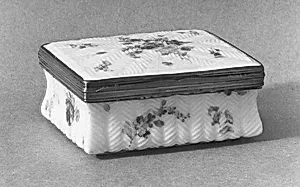
Box
ca. 1750–56
Medium
Soft-paste porcelain, silver
Dimensions
H. 1 1/16 in. (2.7cm)
Classification
Ceramics-Porcelain
Culture
French, Mennecy
Department
European Sculpture and Decorative Arts
Museum
Metropolitan Museum of Art, New York, NY
Credit
Gift of R. Thornton Wilson, in memory of Florence Ellsworth Wilson, 1950
Accession Number
50.211.124
Rights
Public Domain
Art Historical Context
This delicate "Box" from the Mency porcelain manufactory, crafted around 1750–56, exemplifies the exquisite luxury goods of France's Rococo era. Measuring just 1 1/16 inches (2.7 cm) tall, it was likely a snuffbox, patch box, or bonbon—intimate accessories for the aristocracy, who prized such trifles for their refinement and portability. Mennecy, a short-lived but innovative factory near Paris (active 1750–1773), specialized in soft-paste porcelain, a French secret formula blending clay, glass frit, and white ash to mimic costlier Chinese hard-paste porcelain before Sèvres dominated the market. The combination of soft-paste porcelain with silver elements highlights advanced 18th-century techniques: the porcelain body offered a creamy translucency ideal for intricate molding and decoration, while silver mounts added durability and opulence. Though modest in scale, this piece reflects the era's playful elegance, where everyday objects became canvases for artistic whimsy. Now in the Metropolitan Museum of Art's European Sculpture and Decorative Arts collection (gift of R. Thornton Wilson, 1950), it invites us to appreciate the craftsmanship that brought porcelain dreams to life for Versailles society.