
Box
ca. 1745
Medium
Hard-paste porcelain, gilt metal
Dimensions
Overall: 1 1/2 × 2 3/4 × 2 1/8 in. (3.8 × 7 × 5.4 cm)
Classification
Ceramics-Porcelain
Culture
Italian, Florence
Department
European Sculpture and Decorative Arts
Museum
Metropolitan Museum of Art, New York, NY
Credit
Gift of Joseph W. Drexel, 1889
Accession Number
89.2.141
Rights
Public Domain
Tags
Art Historical Context
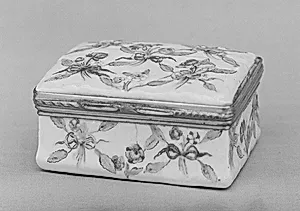
This exquisite porcelain box, crafted by the Doccia Porcelain Manactory around 1745, exemplifies early Italian mastery of hard-paste porcelain technically demanding medium developed at the factory founded in 1735 by Marchese Carlo Ginori near. As Italy's first producer of true porcelain (fired at high temperatures for its signature translucency and durability), Doccia rivaled German leaders like Meissen, blending local artistry with international innovation. The small scale (just 1 1/2 × 2 3/4 × 2 1/8 inches) suggests it served as a luxury trinket box, perhaps for snuff, patches, or jewels, enhanced by ornate gilt metal mounts that add a touch of opulent Rococo flair. Adorned with delicate motifs of flowers and leaves, the box captures the era's fascination with nature's abundance, rendered in vibrant enamels typical of Doccia's output. These designs reflect Florence's rich tradition of decorative arts, where porcelain became a canvas for whimsical, elegant ornamentation amid the mid-18th-century porcelain boom across Europe. A gift to The Metropolitan Museum of Art in 1889 from Joseph W. Drexel, this piece invites visitors to appreciate the tactile beauty of a bygone luxury, bridging craftsmanship and cultural prestige.
About the Artist
Doccia Porcelain Manufactory · 1737–1896
The Doccia Porcelain Manufactory, founded in 1737 by Marquis Carlo Ginori near Florence, holds the distinction of being Italy's first hard-paste porcelain manufacturer and one of the few European porcelain enterprises to survive from the eighteenth century to the present day without interruption. Unlike most contemporary ventures — which depended on the patronage and protection of ruling courts — ...