
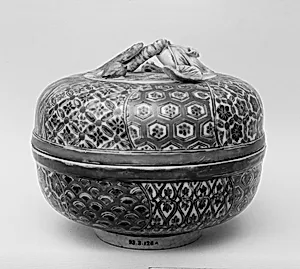
Box and Cover
Unknown Artist
19th century
Medium
Clay covered with crackled glaze and decorated inside and out with polychrome enamels and gold (Satsuma ware)
Dimensions
H. 4 in. (10.2 cm)
Classification
Ceramics
Culture & Period
Japan · Edo (1615–1868) or Meiji period (1868–1912)
Department
Asian Art
Museum
Metropolitan Museum of Art, New York, NY
Credit
Gift of Charles Stewart Smith, 1893
Accession Number
93.3.126a, b
Rights
Public Domain
Tags
Art Historical Context
This exquisite Box and Cover, crafted in 19th-century Japan, exemplifies the refined artistry of Satsuma ware. Standing just four inches tall, the piece features a clay body finished with a distinctive crackled glaze, then lavishly decorated inside and out with vibrant polychrome enamels and gold. Such meticulous ornamentation highlights the technical mastery of Japanese ceramicists during the late Edo (1615–1868) or early Meiji (1868–1912) period, when traditional techniques met growing international interest. Satsuma ware originated in the Satsuma domain of southern Kyushu and became especially prized for its elegant fusion of functionality and beauty. Boxes like this one served both practical purposes—storing small treasures or incense—and as objects of display, reflecting the refined tastes of their owners. The crackled glaze, achieved through controlled firing, creates a delicate network of fine lines that enhance the luminous quality of the enamels and gold, inviting close inspection. Acquired by the Metropolitan Museum through the generous gift of Charles Stewart Smith in 1893, this ceramic represents a bridge between Japanese craftsmanship and global appreciation. Its compact scale and intricate surface decoration continue to offer visitors a tangible connection to Japan’s rich ceramic heritage.