
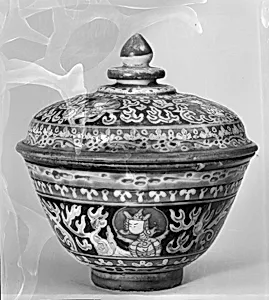
Covered jar with Thai mythical figures
Unknown Artist
19th century
Medium
Porcelain painted in overglaze polychrome enamels (Bencharong ware for Thai market)
Dimensions
H. 4 3/8 in. (11.1 cm); Diam. 4 1/4 in. (10.8 cm)
Classification
Ceramics
Culture & Period
China · Qing dynasty (1644–1911)
Department
Asian Art
Museum
Metropolitan Museum of Art, New York, NY
Credit
Avery Fund, 1909
Accession Number
09.70.23a, b
Rights
Public Domain
Art Historical Context
This exquisite covered jar, standing just 4⅜ inches tall, hails from China's Qing dynasty (1644–1) in the 19th century Crafted by an unknown artist, it exemplifies Bencharong ware—porcelain specifically produced for the Thai market. small, lidded vessel features vibrant overglaze polychrome enam, a technique where colorful enamels are fired onto the glazed surface at lower temperatures, allowing for intricate, vivid designs that wouldn't survive higher kiln heat. The jar's showcases Thai mythical figures, blending Chinese ceramic expertise with Southeast Asian iconography. This cultural fusion highlights the Qing era's extensive export trade, where Jingdezhen potters tailored luxury goods to royal Thai tastes, often incorporating local folklore like garudas or naga serpents. Bencharong, meaning "five colors" in Thai, was prized by nobility for its jewel-like palette and fine detailing. Acquired through the Avery Fund in 1909, this piece now graces the Metropolitan Museum of Art's Asian Art collection. It offers a window into 19th-century global exchange, reminding us how porcelain bridged empires and inspired cross-cultural artistry.