
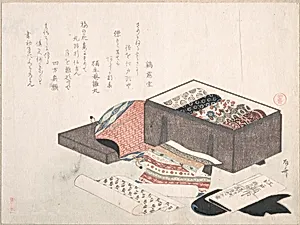
Box with Draperies
19th century
Medium
Woodblock print (surimono); ink and color on paper
Dimensions
8 1/4 x 11 1/6 in. (21 x 28.4 cm)
Classification
Prints
Culture
Japan
Department
Asian Art
Museum
Metropolitan Museum of Art, New York, NY
Credit
H. O. Havemeyer Collection, Bequest of Mrs. H. O. Havemeyer, 1929
Accession Number
JP2226
Rights
Public Domain
Tags
Art Historical Context
**Box with Draperies** Ryūryūkyo Shinsai is a 19th-century wood print from Japan, exemplifying the intimate art of *surimono*. These privately commissioned prints, often produced for poetry circles or New Year's greetings, were luxurious alternatives to commercial *ukiyo-e*, featuring superior craftsmanship with vibrant inks, subtle colors, and sometimes metallic accents. Shinsai, a talented poet-artist active in the late Edo period (around 0–1820, though this work dates later), specialized in such refined compositions, blending his literary sensibility with visual elegance. This small-scale print (8¼ × 11⅙ in.) captures a wooden box adorned with flowing draperies, highlighting Japan's deep appreciation for textiles as symbols of luxury and craftsmanship. The intricate patterns and folds evoke the tactile beauty of silk kimonos and ceremonial fabrics, common motifs in *surimono* that invited contemplation. Woodblock printing techniques—carving precise blocks for each color layer—allowed for Shinsai's masterful depiction of texture and depth on paper, making everyday objects poetic. Housed in the Metropolitan Museum of Art's Asian Art collection as part of the H.O. Havemeyer bequest, this piece offers a window into Edo-period connoisseurship, where art bridged poetry, design, and seasonal celebration. Visitors will appreciate its serene sophistication, a testament to Japan's "floating world" aesthetic.
About the Artist
Ryūryūkyo Shinsai · 1799–1823
Ryūryūkyo Shinsai (柳々居辰斎), active from 1799 to 1823, was a prominent Japanese ukiyo-e printmaker based in Edo (modern Tokyo), renowned for his mastery of surimono—luxurious, privately commissioned woodblock prints produced for elite poetry circles and New Year's celebrations. He began his training under Tawaraya Sōri before becoming a student of the legendary Katsushika Hokusai, from whom he recei...