
Boy Doll
c. 1937
Medium
watercolor, gouache, and graphite on paper
Dimensions
overall: 30.9 x 24.5 cm (12 3/16 x 9 5/8 in.) Original IAD Object: 18" high
Classification
Index of American Design
Department
CG-W
Museum
National Gallery of Art, Washington, D.C.
Credit
Index of American Design
Accession Number
1943.8.15360
Rights
Public Domain
Art Historical Context
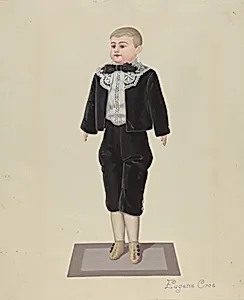
**Boy Doll**, a captivating watercolor, gouache, and graphite rendering by Eugene Croe from around 1937, brings to life an 18-inch folk art doll through meticulous detail on a modest 30.9 x 24.5 cm sheet of paper. Part of the National Gallery of's esteemed Index of American Design collection this work exemplifies the precision of traditional craft objects, capturing the doll's form, fabrics, and subtle expressions with a blend of translucent watercolor washes, opaque gouache highlights, and fine graphite lines for texture and contour. Created under the Works Progress Administration (WPA) during the Great Depression, the Index of American Design employed artists like Croe to document everyday American folk art, preserving cultural heritage amid economic hardship. This project produced thousands of plates celebrating regional craftsmanship, from quilts to carvings, fostering national pride in vernacular design. Gouache's vibrancy and watercolor's fluidity were ideal for faithfully reproducing the doll's colors and three-dimensionality, turning a humble toy into a study of artistic ingenuity. Today, *Boy Doll* invites us to appreciate the whimsy and skill of anonymous makers, evoking childhood innocence and the enduring appeal of handcrafted playthings in American life. A testament to both folk tradition and Depression-era creativity, it reminds visitors of our shared design legacy.
About the Artist
Eugene Croe · 1875–1953
Eugene Croe (c. 1875–1953) was an American artist whose career is primarily documented through his contributions to the Index of American Design, a Federal Art Project under the Works Progress Administration (WPA) during the 1930s and 1940s. This ambitious initiative commissioned artists to create precise illustrations of American folk art, decorative arts, and everyday objects, preserving a visua...