
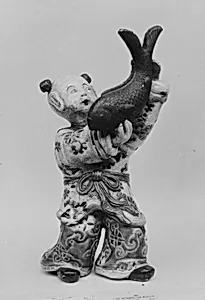
Boy Holding up a Carp
Unknown Artist
1860
Medium
Faience decorated in colored enamels and gold (Satsuma ware)
Dimensions
H. 10 3/4 in. (27.3 cm); W. 6 in. (15.2 cm); D. 4 in. (10.2 cm)
Classification
Ceramics
Culture & Period
Japan · Edo period (1615–1868)
Department
Asian Art
Museum
Metropolitan Museum of Art, New York, NY
Credit
Gift of Mrs. V. Everit Macy, 1923
Accession Number
23.225.353
Rights
Public Domain
Tags
Art Historical Context
This delightful ceramic sculpture, *Boy Holding up a Carp captures a joyful moment from late Edo-period Japan around 1860. Crafted in Satsuma ware—a prized faience adorned with vibrant colored enamels and gold—the stands about 10¾ inches tall, showcasing the era's mastery of intricate, multi-layered decoration. The unknown artist skillfully modeled a young boy triumphantly lifting a large carp, evoking playfulness and vitality in its three-dimensional form. Satsuma ware, originating from Japan's Kyushu region, flourished during the Edo period (1615–1868) and became renowned for its rich polychrome enameling on a creamy base, often featuring figural scenes for both domestic and export markets. This artwork exemplifies the period's technical innovation in ceramics, blending sculptural realism with decorative flair. The carp, a symbol of perseverance and strength in Japanese culture—famously leaping upstream in folklore—pairs with the boy to hint at themes of youthful aspiration, possibly nodding to Boys' Day celebrations. A gift to the Metropolitan Museum of Art in 1923, this charming piece invites visitors to appreciate the Edo era's blend of everyday whimsy and artistic excellence, bridging Japan's artistic heritage with universal motifs of growth and determination.