
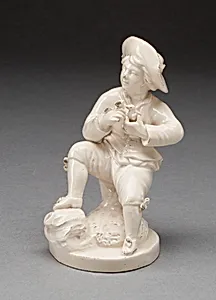
Boy with Two Birds
c. 1775
Medium
Lead-glazed earthenware
Dimensions
H.: 10.2 cm (4 in.)
Classification
tin-glazed ware
Department
Applied Arts of Europe
Museum
Art Institute of Chicago
Accession Number
82314
Rights
Public Domain
Art Historical Context
Nestled in the Art Institute of Chicago's Department of Applied Arts of Europe *Boy with Two Birds* a delightful example of 18th-century tin-gl ware. Crafted around 1775 by an unknown, this petite figurine stands just 10.2 cm (4 in.) tall, fashioned from lead-glazed earthen—a medium prized for its glossy finish and vibrant potential. The young boy, tenderly holding two birds, captures a moment of innocence and connection to nature, typical of the period's decorative ceramics that adorned bourgeois homes. This piece reflects the flourishing European ceramic traditions of the late 1700s, particularly in England and the Low Countries, where tin-glazed earthenware (often called delftware or faience) allowed artisans to mimic costly Chinese porcelain at affordable prices. The lead glaze not only sealed the porous clay for durability but also enabled bold colors and detailed modeling, making such figurines accessible status symbols and conversation starters. Though anonymous, the sculptor's skill shines in the lively pose and expressive details, highlighting the cultural role of these objects in evoking sentimentality and everyday joys. A charming survivor of domestic life, it invites us to ponder the simple pleasures valued in Georgian-era Europe.
About the Artist
Unknown
The artist designated as "Unknown" in our virtual museum's collection exemplifies a poignant chapter in art history: creators whose identities have faded into obscurity despite the enduring power of their work. With only one known artwork attributed to them in our holdings, this figure represents countless anonymous hands that shaped visual culture across centuries. Museums worldwide, including th...