
Boys in a Dory
1873
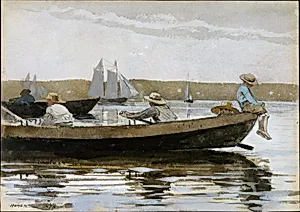
Medium
Watercolor washes and gouache over graphite underdrawing on medium rough textured white wove paper
Dimensions
9 3/4 x 13 7/8 in. (24.8 x 35.2 cm)
Classification
Watercolor
Culture
American
Department
The American Wing
Museum
Metropolitan Museum of Art, New York, NY
Credit
Bequest of Molly Flagg Knudtsen, 2001
Accession Number
2001.608.1
Rights
Public Domain
Tags
Art Historical Context
Winslow Homer's *Boys in a Dory* (1873) captures a timeless moment of youthful adventure on the water, showcasing two boys rowing a small dory—a traditional flat-bottomed fishing boat common along the New England coast. Painted during Homer's productive summer in Gloucester, Massachusetts this work reflects his fascination with everyday American life in the post-Civil War era, where children embodied resilience and harmony with nature. Homer, a leading figure in American Realism, masterfully employed watercolor washes and gouache over graphite underdrawing on textured wove paper. This intimate 9 3/4 x 13 7/8-inch sheet highlights his innovative technique: translucent washes evoke the shimmering sea and sky, while opaque gouache adds bold highlights and depth, pushing watercolor beyond its traditional limits. The rough paper texture enhances the sense of movement and spontaneity. Housed in The Metropolitan Museum of Art's American Wing, this bequest from Molly Flagg Knudtsen exemplifies Homer's enduring influence on depicting coastal culture and boyhood freedom, inviting viewers to feel the salt spray and summer breeze.
About the Artist
Winslow Homer · 1836–1910
Winslow Homer (1836-1910) was one of America's greatest painters and a preeminent figure in 19th-century American art. Largely self-taught, Homer began his career as a commercial illustrator and Civil War correspondent for Harper's Weekly before becoming renowned for his powerful marine subjects and landscape paintings. His mastery of both oil and watercolor, combined with his uncompromising reali...