
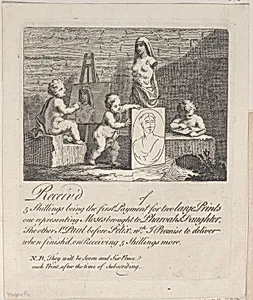
Boys Peeping at Nature
18th century
Medium
Etching
Dimensions
Sheet: 6 3/4 × 5 1/2 in. (17.1 × 14 cm)
Classification
Prints|Ephemera
Department
Drawings and Prints
Museum
Metropolitan Museum of Art, New York, NY
Credit
Gift of Bella C. Landauer, 1926
Accession Number
26.28.357
Rights
Public Domain
Art Historical Context
William Hogarth's *Boys Peeping at Nature (18th century) captures the artist's signature satirical wit through a playful pointed scene. As a pioneering English artist (1697–1764), Hogarth was renowned for his moralistic series like *A Harlot's Progress* and *A Rake's Progress which critiqued the vices and follies of Georgian society. This etching, modestly sized at 6 3/4 × 5 1/2 inches, likely pokes fun at youthful curiosity or voyeurism, blending humor with subtle social commentary on innocence encountering the raw forces of nature. Etched on a small sheet, the work exemplifies Hogarth's mastery of printmaking techniques, combining fine lines and tonal effects to create affordable, widely circulated images. Etching allowed Hogarth to bypass traditional patronage, democratizing art for the emerging middle class and amplifying his role as a "painter of modern moral subjects." Housed in the Metropolitan Museum of Art's Drawings and Prints department (gift of Bella C. Landauer, 1926), it reflects the era's fascination with ephemera—transient prints that packed enduring punch. This piece invites visitors to ponder Hogarth's enduring legacy: using everyday mischief to mirror human nature, making high art accessible and provocatively relevant.
About the Artist
William Hogarth · 1697–1764
William Hogarth (1697-1764) was an English painter, printmaker, and pictorial satirist who became the first great English-born artist to attract admiration abroad. Born into poverty in London, the son of a failed schoolmaster who was imprisoned for debt, Hogarth's early experiences with the harsh realities of 18th-century urban life profoundly shaped his artistic vision. After apprenticing with si...